Advancing digital, media, and information literacy in Cambodia
Cambodia’s Digital, Media, and Information Literacy Competency Framework (DMIL) laid out the pathway in response to the urgent need to develop the “Digital Citizen,” which is an integral part that supports the current vibrant digital economy and society. Against this backdrop, the panel discussion on “Advancing Digital, Media, and Information Literacy in Cambodia” is essential in highlighting Cambodia’s growing efforts, with a focus on empowering students, educators, and the wider public.
Moderated by Ms. Thida Sours, Communication Officer, Open Development Cambodia (ODC), featuring Ms. Nasa Dip, Project Coordinator at the Ministry of Post and Telecommunications (MPTC), Mrs. Ith Channa, Representative of the Ministry of Education, Youth and Sport (MoEYS), and Ms. Hok Lida from Media 101, the panel discussion explored the progress and future of Digital, Media, and Information Literacy (DMIL) in Cambodia, highlighting its critical role in education, governance, and society.
Ms. Thida Sours kicked off the discussion by sharing ODC’s experiences. ODC has been at the forefront of strengthening DMIL in Cambodia through comprehensive, inclusive training programs such as the Media Information and Digital Literacy (MIDL) Training of Trainers (ToT) workshop supported by UNDP Cambodia. The initiatives have reached over 300 youth and 90 persons with disabilities, providing critical skills in media analysis, misinformation awareness, and safe digital practices. Through the CLAP Project in Cambodia and Laos, with funding support from Organisation internationale de la Francophonie, ODC trained 22 master trainers who delivered 40 workshops, benefiting around 1,500 teachers, students, parents, and community members. Overall, ODC’s work fosters responsible digital engagement and builds community resilience against misinformation.
From the government perspective, Ms. Nasa Dip brought the discussion to life with interactive quiz questions that made participants think about their own digital habits. Questions like “What comes to mind when you hear DMIL?” and “How much fake news do you think you can spot?” sparked reflection. She explained why digital literacy is now inseparable from media literacy: with social media dominating as the main news source and some print media fully online since 2024, understanding what’s real and what’s misleading is no longer optional.
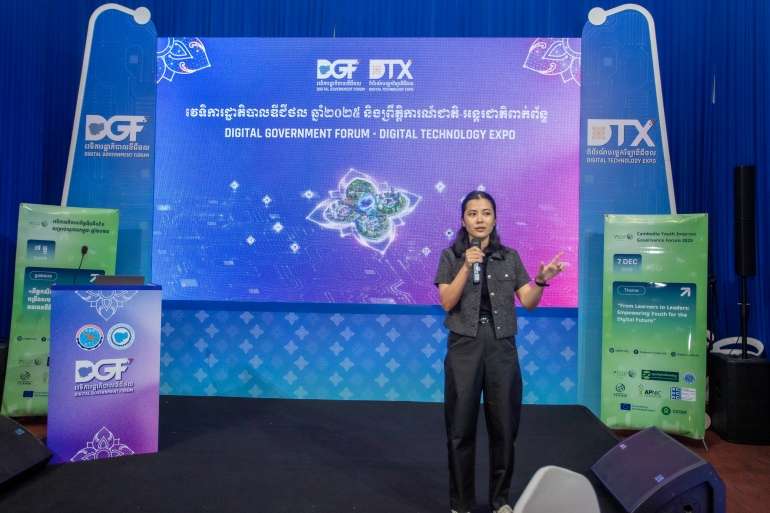
She outlined the eight key DMIL competencies, ranging from information and data literacy to digital content creation, media literacy, and problem-solving, and explained why they matter. With only 32% of Cambodians having basic digital access, 5% intermediate, and just 1% advanced skills, the need for these competencies is urgent. DMIL equips youth and adults alike to verify information, protect personal data, navigate online risks, and make the most of digital opportunities. She also shared a MIL Gamer Quiz via QR code, showing that learning can be interactive and engaging.
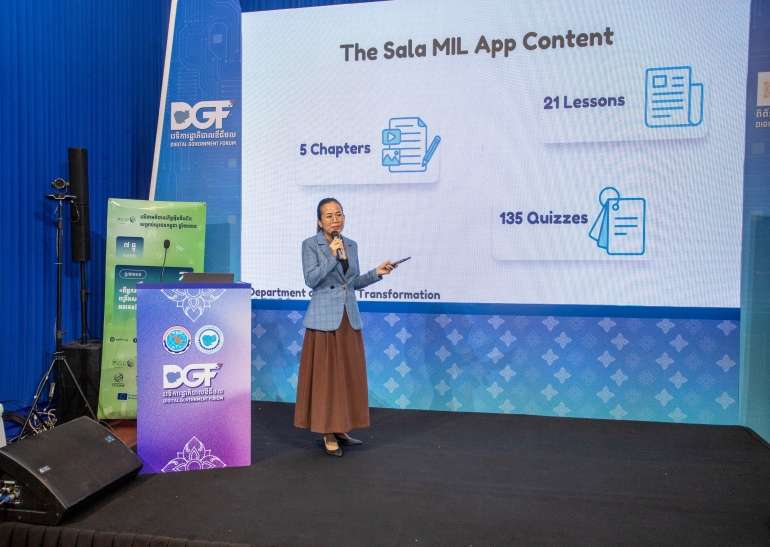
Mrs. Ith Channa then dove into the Sala MIL app, Cambodia’s very own digital literacy toolkit. With 21 lessons, 5 chapters, 135 Q&As, videos, interactive content, quizzes, and certificates, it’s built for students, teachers, and youth, even in areas with weak internet. Sala MIL helps users think critically, stay safe online, check information, avoid scams, and build responsible digital habits. Teachers also get ready-made activities, making digital literacy easy to integrate into the classroom. “It’s like having a digital mentor in your pocket,” Mrs. Ith Channa said.
Ms. Hok Lida added a playful twist by revisiting a childhood classic, the two-cup telephone game, to show how information can get distorted. The cups represent the sender and receiver, while the string represents the communication channel. Tight string? Clear message. Loose string? Confusion. Just like online content, messages can easily be twisted.
Lastly, she introduced five core MIL concepts: access media responsibly, analyze content effectively, identify the sender, understand their intentions, and recognize emotional manipulation. MIL isn’t just about knowledge; it’s about thinking critically, avoiding scams, and making smart choices online.
As Cambodia races toward a digital future, DMIL is no longer a luxury but a necessity. From Sala MIL to national training programs, these initiatives are equipping students, teachers, and youth with the skills to navigate online spaces safely, responsibly, and confidently. In a world overflowing with information, knowing what to trust is more than a skill. It’s a superpower.

