AI and disinformation on digital platforms
Artificial intelligence (AI) has transformed the way information is created and shared, but it has also intensified the spread of mis- and disinformation. As Cambodia prepares its Draft National AI Strategy (2025-2030), information integrity is an element that cannot be neglected.
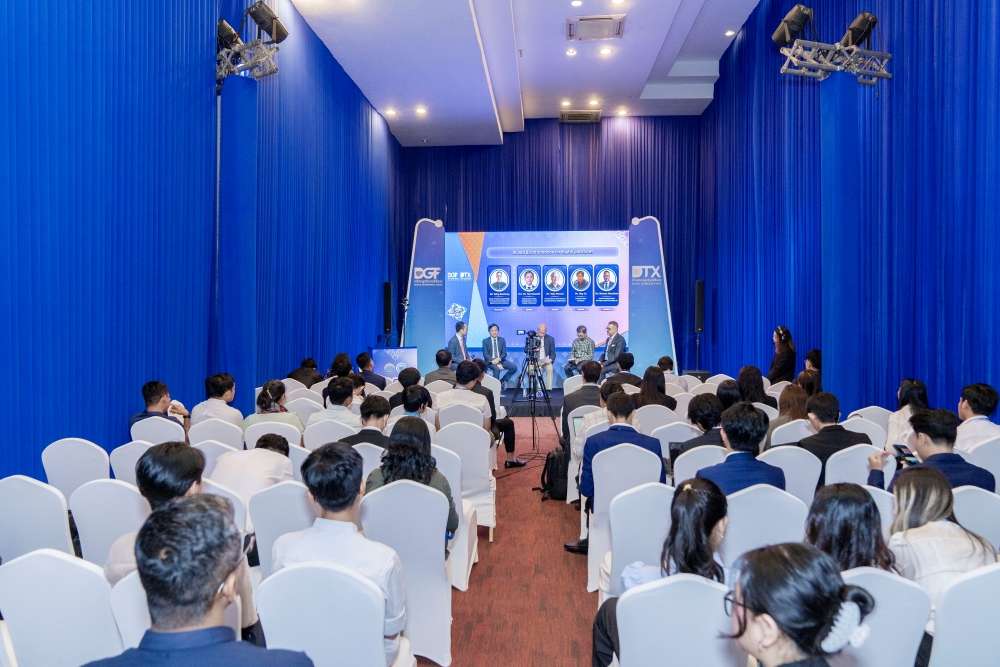
It is against this backdrop that the panel discussion on “AI and Disinformation on digital platforms” took place. Moderated by Mr. Taing Bunhong, Director of the Department of Policy and Legal Affairs at the General Secretariat of the Digital Government Committee, the session featured H.E. Mr. Tep Asnarith, Undersecretary of State and Spokesperson for the Ministry of Information, Mr. Toby Mendel, Executive Director of the Center of Law and Democracy, UNESCO Expert, Mr. Nop Vy, Executive Director of CamboJA, and Mr. Naveen Vasudeva, Founder of Strategic Capital Risk Expert, CyberTree Paradox LTD. Jointly, they shared insights on how AI-driven falsehoods are affecting societies, journalists, and institutions, as well as the steps needed to mitigate these risks.

Mr. Toby Mendel began by distinguishing between misinformation (false information shared unknowingly) and disinformation (false information shared intentionally). He reminded the audience that misleading information has existed long before AI; what’s new is the unprecedented speed and scale at which AI can amplify it.
He noted that misinformation has already caused significant harm, especially to children, in ways that are often difficult to fully measure. Deepfake technology, in particular, can damage reputations and spread fabricated narratives within minutes. AI does not necessarily create misinformation, but it supercharges its dissemination. He urged the public not to normalize irresponsible or malicious behavior online, stressing that deliberately spreading false information should never be treated lightly. To support global efforts, he highlighted UNESCO’s guidelines and tools designed to help individuals and institutions navigate and combat misinformation.
H.E. Mr. Tep Asnarith explained that Cambodia is indeed facing the same challenges of fake news as countries like Canada, possibly even more intensely. As a developing country, many Cambodians are still new to digital technology and AI, making them more susceptible to online manipulation. He pointed out that even advanced countries such as the United States struggle with these issues, especially during elections when AI-generated fake news can influence public opinion on a massive scale.
When it comes to the media and journalism perspective, Mr. Nop Vy explained how fake news directly undermines journalism. It often spreads faster than verified reporting, overshadowing legitimate media outlets. As a result, trust in real journalism is eroding, leaving the public increasingly unable to distinguish between credible information and fabricated content. To combat the spread of false information, he emphasized two essential practices, including verifying the source before sharing any news and avoiding blindly trusting content, especially when it comes from social media, where falsehoods proliferate easily.
Mr. Toby Mendel noted that fake news has significantly decreased over the past two years, thanks to efforts by the Ministry of Information. Key initiatives include strengthening cooperation among government ministries to address misinformation, enhancing the skills and professionalism of journalists and media organizations, developing a government-backed verification platform for citizens to check the authenticity of news, and requiring journalists to meet professional standards and obtain government certification.

From a strategic capital risk perspective, Mr. Naveen Vasudeva highlighted the need for substantial investment in preventive technologies and digital safety measures. He explained that more adaptive and advanced solutions are currently being explored to address evolving misinformation threats, ensuring societies can stay resilient in the years ahead.
To bolster the efforts, Open Development Cambodia (ODC), supported by UNDP Cambodia, provided the Media Information and Digital Literacy (MIDL) Training of Trainers (ToT) workshops for 24 representatives, including 5 female, from Sub-National Democratic Development Secretariat (NCDD-S), municipality administrations, the National School of Local Administration (NASLA), and CSOs in Kampong Cham (Kampong Cham Province), Banglung (Ratanakiri Province), Siem Reap (Siem Reap Province) and in Phnom Penh on 22th-24th January 2025. This workshop successfully equipped participants with the knowledge and skills needed to navigate digital platforms responsibly and prepared participants to deliver MIDL training to community members.
Under the Cambodia-Laos Awareness and Preparedness (CLAP) initiative, and with support from the Organisation internationale de la Francophonie (OIF) in collaboration with the National Committee for Lifelong Learning (NCLLL), ODC conducted a Training of Trainers (ToT) on Media and Information Literacy (MIL) on 7-8 October 2025 at Cambodia University of Specialties (CUS) in Kampong Thom province. The training aimed to strengthen participants’ ability to detect and analyze false or misleading information, while engaging them in co-designing approaches to effectively disseminate MIL knowledge within their communities.
As part of CLAP, two ToT workshops were organized. With small grants from ODC, trained MIL master trainers went on to conduct 47 community-based workshops, reaching approximately 1,969 students, teachers, parents, and community members (773 males and 1,196 females) across Preah Vihear and Kampong Thom provinces. Through these sessions, participants developed practical skills to identify fake news, protect themselves from misinformation, and engage responsibly on social media.
AI may spread false information faster than ever, but vigilance can fight back. By verifying sources, supporting professional journalism, and using smart digital tools, we can slow misinformation and protect the truth. Around the world, staying informed and critical is the best defence in the digital age.